
In the high-precision metal manufacturing landscape, selecting the appropriate production method—Progressive Die Stamping or Multislide (Fourslide) Forming—is a critical decision that dictates long-term production efficiency, material utilization, and part performance. As designs for Electric Vehicles (EV), medical devices, and telecommunications grow in complexity, manufacturers must move beyond traditional vertical-press constraints to optimize their supply chains.
The primary distinction between these two technologies lies in the direction of force applied to the metal and the flexibility of the tooling arrangement.
• Progressive Die Stamping: This process relies on a linear vertical motion where a metal strip advances through a single die set. Cutting and bending occur as the press moves vertically, which often necessitates complex “cam-action” inserts to achieve non-vertical bends, increasing both cost and mechanical risk.
• Multislide Forming: A multislide machine utilizes a radial arrangement where tools move horizontally from multiple angles. This provides 360-degree access to the workpiece, allowing for intricate 3D geometries and interlocking bends to be achieved in a single cycle.
Efficiency in modern manufacturing is measured not just in output, but in the ability to adapt to design changes quickly.
• High-Volume Output: Multislide systems are engineered for high-speed production, capable of producing hundreds of parts per minute. This makes the process significantly faster and more cost-effective than traditional progressive stamping for complex components.
• Modular Tooling Design: Unlike the monolithic die sets used in progressive stamping, multislide tooling is modular. This modularity offers greater design flexibility and results in lower die costs.
• On-Machine Adjustments: A major advantage for reducing downtime is the ability to make tooling adjustments directly on the machine without taking apart the entire tooling die. This allows engineers to fine-tune the forming process in real-time, ensuring consistent quality with minimal disruption.
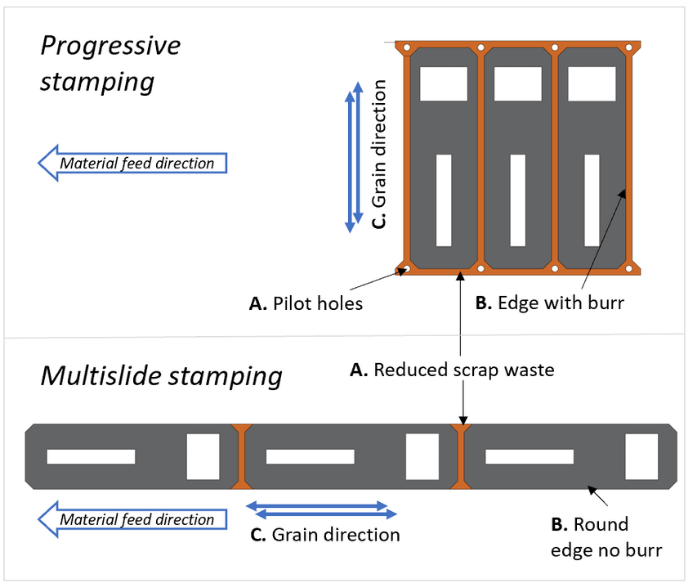
Material costs often constitute the largest portion of a component’s price, especially when working with bronze, copper, or high-grade stainless steel.
• Eliminating Pilot Holes: In progressive stamping, the material strip must be wider than the final part to accommodate “pilot holes” and carrier strips that transport the metal between stations.
• Width Optimization: Multislide technology often eliminates side scrap entirely because the raw material width can equal the final product width.
• 30% Yield Improvement: By eliminating the need for pilot holes and carriers, multislide machines typically produce approximately 30% less scrap than traditional stamping. This efficiency leads to significantly lower material costs for high-volume runs.
For parts subject to constant mechanical stress, such as cage springs, contact springs, and fuse clips, the internal structure of the metal is paramount.
• Parallel Feed Logic: In multislide forming, the material feeds parallel to the grain (rolling) direction. This differs from progressive stamping, where part orientation is often compromised to fit the die layout.
• Crack Prevention: Aligning the material feed with the grain direction enhances fatigue resistance and effectively prevents cracks from forming around the bending regions. This ensures superior mechanical properties and part longevity in demanding clamp applications.
Precision components in the medical and electronics sectors require a superior finish to prevent electrical interference or mechanical failure.
• Burr Management: Progressive stamping often leaves cutting burrs on the edges of the part where it was punched from the sheet.
• Pre-Processed Edges: Multislide technology allows for parts with round side edges and no burr. This is possible because the raw material can be pre-processed or deburred before it is fed into the machine, resulting in a cleaner, safer finished component.
At DLTEK, we combine 30 years of industrial mastery with a Singapore-invested engineering heritage to provide high-performance multislide solutions. Our DV NC Series is designed to leverage these mechanical advantages to help our partners build world-class products.
• DV8 NC: A high-speed specialist for micro-components like terminal blocks and surgical staples.
• DV20 NC: Our most versatile flagship, optimized for EV battery pins and complex industrial fasteners with simplified tooling design.
• DV50 NC: A heavy-duty system for EV busbars and automotive brackets requiring up to 50 tons of force.





for more information about our products,
exhibition events, or other details.

