
The multislide machine emerged from the industrial need to manufacture complex, multi-directional precision metal components with high accuracy and consistency at scale. While conventional power presses remain effective for straightforward stamping, they are inherently limited when parts require multi-axis forming from multiple directions in a single cycle.
This technical gap led to the development of fourslide and later multislide stamping and bending machines. These specialized systems integrate cutting, bending, and shaping of metal strip and wire within one automated process. Today, multislide technology plays a critical role in high-volume precision manufacturing across the automotive, electrical, and industrial hardware industries.
The origins of multislide technology trace back to the mid-19th century in Connecticut, USA. In 1854, E.J. Manville introduced one of the earliest wire-forming mechanisms utilizing multiple slides to shape material around a central mandrel. This laid the groundwork for the fourslide metal forming machine.
By the late 1800s, manufacturers such as Baird Co. and A.H. Nilson refined the technology. Machines of this era were predominantly horizontal, with forming slides moving across a flat bed. Mechanical cams and master shafts synchronized the forming actions, enabling high-speed, repeatable production of intricate wire forms and stamped metal strip components for the hardware and electrical markets.
As industrial applications evolved in the mid-20th century, demand increased for tighter tolerances and improved process stability. European machine builders introduced a significant architectural shift: the transition to a vertical machine orientation, pioneered by Finzer.
Positioning forming slides vertically around the mandrel delivered two practical advantages: gravity-assisted scrap removal, which reduces debris in the tooling area, and improved accessibility for setup and maintenance. These benefits led to the widespread adoption of the Finzer ZUB series—notably the ZUB 200 and ZUB 220 models—across Europe and Asia. The vertical multislide platform became a recognized standard for manufacturing complex automotive and electrical components with long-term production stability.
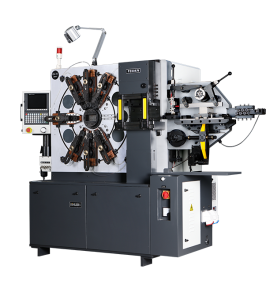
Multislide machines continue to be the preferred solution for high-volume precision metal forming due to their 360-degree access to the workpiece. By forming material from multiple radial directions around a central mandrel, these systems produce complex 3D bends and interlocking geometries not feasible on a standard stamping press.
Modern systems also feature higher structural rigidity to process thicker and higher-strength materials. Most integrate a dedicated press station for piercing or notching before the bending sequence. For example, our DLTEK’s DV series incorporates a press station rated up to 50 metric tons and processes stainless steel up to 60 mm in width and 3.0 mm in thickness—ideal for EV busbars, electrical connectors, and structural parts.
DLTEK brings over 30 years of experience in automated multislide stamping and bending manufacturing. Our development is rooted in the vertical multislide platform, refined in response to real-world requirements from global customers in the automotive and electrical sectors.
As the market shifted toward higher flexibility and precision, DLTEK evolved from fully mechanical systems to advanced hybrid solutions:
Today, DLTEK operates as a global supplier of high-precision multislide machines, delivering the accuracy and material efficiency required for EV busbars, motor hairpins, and stepless ear clamps.
With over 30 years of experience, our solutions are developed by an in-house team of skilled tooling designers and makers, many of whom received professional training in Singapore. DLTEK machines are delivered worldwide, CE certified, and supported by multiple patented technologies. We remain committed to our guiding principle: To build a world-class product. We focus on optimizing production efficiency and reduces material waste.
Explore our application portfolio in automotive, electrical, and other precision metal forming industries, or contact us to discuss your multislide machine and tooling requirements with our technical team.





for more information about our products,
exhibition events, or other details.

