
Automotive latch springs, spring clips, and retaining clamps are critical to vehicle safety and mechanical performance. Found in door locks, seat mechanisms, and hood latches, these components must withstand hundreds of thousands of actuation cycles under severe mechanical stress and temperature fluctuations.
For automotive purchasers and manufacturing business owners, the challenge isn’t just achieving high fatigue resistance and tight dimensional tolerances, the real challenge lies in optimizing manufacturing economics and raw material usage.
If you are currently sourcing or manufacturing complex automotive clips, your choice of forming technology directly dictates your profit margins.
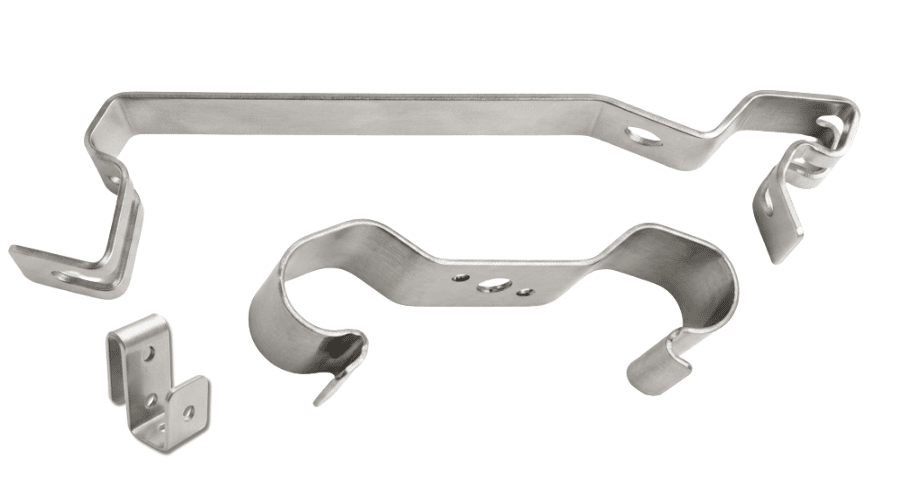
To balance high elasticity with structural durability, automotive spring clips typically require high-carbon spring steels (such as C67S or C75S) or stainless spring steels. Because these premium alloys represent a significant percentage of the total part cost, raw material yield is the most critical metric in your production economics.
The Limitations of Traditional Progressive Stamping
Many global manufacturers default to traditional progressive die stamping for high-volume automotive runs. While efficient for flat profiles, progressive stamping relies strictly on a single vertical axis. To form multi-directional, overlapping bends, the tooling requires complex internal cam mechanisms.
More importantly, progressive stamping is structurally “material-hungry.” It requires a wide web carrier strip and pilot holes to transport the metal coil through the die stations. This design means you are frequently paying for 20% to 30% more raw material than the final part actually requires, throwing valuable alloy scrap directly into the bin.
For intricate 3D automotive profiles, moving beyond vertical-press thinking to 360-degree radial multislide forming offers a massive competitive advantage.
Instead of cutting a part out of a wide sheet, radial forming feeds raw material at its exact final width (preserving the smooth, mill-quality factory edge). Multiple synchronized, independent slides strike the metal strip from different axes in a single operation around a central mandrel.
This process delivers three critical advantages for high-volume automotive suppliers:
For European and global manufacturers accustomed to premium European multislide forming machinery, finding a cost-effective, high-precision alternative that maintains world-class reliability is essential to staying competitive.
Our advanced technology provides the exact same modular precision, micron-level adjustability, and high-volume stability you expect from market leaders—but at an optimization level that significantly reduces your initial tooling and capital investment. You no longer have to compromise between European engineering standards and localized cost efficiency.
At DLTEK, we specialize in maximizing material yield and component reliability through our advanced DV Series NC multislide machinery. We don’t just supply equipment; we engineer solutions that eliminate secondary operations and maximize your margins.
To support our customers’ global footprints, DLTEK has established an extensive international network. With dedicated working partners and localized technical support across Europe, the United States, South America, and South East Asia, we ensure that world-class manufacturing efficiency is always within your reach.
Ready to eliminate your carrier scrap and optimize your next automotive production run? 👉 Contact our global engineering team today to analyze your part design.





for more information about our products,
exhibition events, or other details.

